
Benchmark indices fell sharply on Monday, with the Sensex and Nifty tumbling nearly 2 per cent each amid weak global market trends and foreign fund outflows. Falling for the fourth straight day, the 30-share BSE Sensex tanked 953.70 points or 1.64 per cent to settle at 57,145.22. During the day, it plummeted 1,060.68 points or 1.82 per cent to 57,038.24.

For the first time after the government took drastic steps to rein in runaway price rise, inflation slipped to 7.14 per cent in the week ended April 5, 2008. In the previous week inflation had surged to a 40-month high of 7.41 per cent, mounting pressure on the Reserve Bank to further tighten money supply in its forthcoming annual credit policy later this month.

Among Sensex components, shares of Reliance Industries, India's largest company by market value, stole the show by surging 1.61 per cent to their highest in over three months.

Dealers attributed the rupee's weakness to dollar gains.

Mahapatra committee observes extraordinary rise in restructured assets With debt recasts rising substantially over the past two years and a major part of such loans threatening to slip to the non-performing category, Indian banks' credibility will be at stake in case of a latter scenario, the Reserve Bank of India said on Thursday.

ITC, Sun Pharma, Maruti, M&M, Tata Motors, HCL Tech, Wipro, Infosys, HUL, Bharti Airtel and Reliance were among the major losers. Kotak Bank rose the most by 1.59 per cent, followed by IndusInd Bank, Bajaj Finance and Bajaj Finserv. L&T, SBI, TCS and HDFC Bank also closed higher.

Bharti Airtel was the top loser in the Sensex pack, slipping around 1 per cent, followed by Tata Steel, HDFC Bank, Infosys, HDFC, Bajaj Auto and PowerGrid.

The amount of loans that carry a high risk of slippage into the NPA category over the next few quarters is about Rs 2.8 trillion.

Stocks of small- and mid-cap companies continued to gain ground in July, notwithstanding analysts sounding caution on these two market segments given the sharp run thus far in calendar year 2023 (CY23). Sanjeev Prasad, co-head of Kotak Institutional Equities, in a note co-authored with Anindya Bhowmik and Sunita Baldawa in June-end, had cautioned against the sharp run in small- and mid-caps. "We do not see any particular reason for the excitement in small- and mid-cap stocks.

After a sharp outperformance in the mid-and small-cap segments in the first half of calendar year 2023 (H1-CY23), analysts are now turning cautious on these two market segments and suggest investors stay selective and look for valuation comfort and earnings visibility before investing. The S&P BSE Midcap index has surged 13.7 per cent in H1-CY23, and the S&P BSE Small-cap index gained 12.7 per cent during this period, data shows. The S&P BSE Sensex, in comparison, has moved up 6.4 per cent.

The domestic benchmark indices - the S&P BSE Sensex and the National Stock Exchange Nifty50 - had lost close to 1.5 per cent in three days recently before gaining slightly. Notwithstanding weakness and volatility, the Nifty50 has managed to hold on to the 18,000 mark, while the Sensex has managed to stay above the 61,000 level. The performance of the stocks that comprise these front-line indices remains polarised.

Domestic stock markets would be driven by inflation numbers, global trends, and the last batch of Q4 earnings this week, analysts said. Markets will also react to industrial production data and consumer inflation numbers that were released after market hours on Friday. "Participants will react to macroeconomic data viz. IIP and CPI first, which were released post-market hours on Friday.
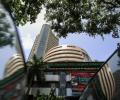
Market sentiment suffered a jolt after other Asian markets closed with widespread losses and European markets dropped in early trade

ICICI Bank, HUL, HDFC Bank, M&M, Ultra Cement, IndusInd Bank and Tech Mahindra were among the losers in the Sensex pack. NSE Nifty slipped 13.95 points to 17,355.30.

Benchmark Sensex trimmed early gains to close marginally higher while Nifty settled flat in choppy trade on Tuesday as gains in auto shares were offset by selling pressure in banking and energy shares. The 30-share BSE barometer closed marginally up by 37.08 points or 0.06 per cent to 60,978.75 with 15 of its stocks ending in green and the rest in red. The index opened higher and gained over 300 points to a high of 61,266.06 in early trade.
HDFC Bank, Tata Steel and Tata Motors among top losers for the day.
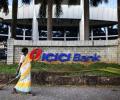
Consensus continues to be cautious with analysts pointing towards tougher days ahead

Indian banks are the 2nd-fastest-growing ones.
The overnight call rate is seen in a range of 8-10 per cent till mid-February, as banks would take some time to soften credit growth.

Equity benchmarks Sensex and Nifty gave up early gains to close in the red on Wednesday after a selloff in power, metal and consumer durable stocks amid a weak trend in global equities. However, a rally in the rupee against the US dollar and unabated foreign capital inflows helped the indices restrict the losses, traders said. In a largely range-bound session, the 30-share BSE Sensex ended 151.60 points or 0.25 per cent lower at 61,033.55.

This time Modi has no emotive message to take to the stump. Muscular nationalism doesn't work against the backdrop of China's successive inroads into Indian territory. Rising prices is a sore point that cuts across class and caste barriers; unprecedented levels of unemployment has the youth in a ferment. This has reduced the BJP campaign to a laundry list of recycled grievances and thinly veiled communal appeals, neither of which are working as well as they have in the past, argues Prem Panicker.

Equity MF schemes recorded worst inflows in three and a half years at Rs 1,311 crore for November. Investors across the board have taken money off the table as markets have scaled new highs. Industry experts said SIPs had stayed intact, which is a healthy sign for the MF industry.

The Indian equity market is likely to remain under pressure and rangebound over the next few months. This comes as global central banks, led by the US Federal Reserve look at a possibility of hiking rates aggressively to tame inflation. Back home, the Reserve Bank of India, too, remains data dependent in its endeavour to keep inflation in check and pursue an aggressive monetary policy stance.

As the clean-up has taken hold, loan growth slipped to 10.7 per cent in the last fiscal

Kotak Bank was the top loser in the Sensex pack, shedding over 2 per cent, followed by Dr Reddy's, M&M, PowerGrid, NTPC, Nestle India and HDFC Bank. NSE Nifty slipped 37.05 points to 15,709.40.

The recent surge in crude oil prices could shave off the gains made by India Inc in profit margins in the past few quarters. Worse, it comes at a time when consumer demand in the country is slipping and major global economies are witnessing a slowdown. A back-of-the-envelope calculation suggests that the margin expansion accounted for three-fourths of the rise in the listed firms' operating profit between the April-June quarter (Q1) of FY23 and Q1FY24, and only a quarter of profits gains came from revenue growth.

Analysts are divided on their retail price inflation forecast, with some saying the first quarter numbers will overshoot the RBI target by as much as 60 bps while others are softer in their estimate. Consumer price inflation retreated from its 15-month peak of 7.4 per cent in July to 6.8 per cent in August, much lower than the market expectations, despite vegetable prices remaining elevated at 26.1 per cent. Food inflation eased to 9.9 per cent from 11.5 per cent, led by some cooling of inflation in vegetables, cereals, pulses and milk.

A Europe-like cyber security defence alliance is the need of the hour, say banking technology experts.
Benchmark indices ended lower on Wednesday after a four-day rally amid a mixed trend in global equity markets. After a positive beginning, the 30-share BSE Sensex failed to hold on to the gains and ended 215.26 points or 0.35 per cent lower at 60,906.09. During the day, it slipped 326.96 points or 0.53 per cent to 60,794.39.

The bank saw loans worth Rs 7,000 crore (Rs 70 billion) slipping into NPAs during the March quarter, taking the gross NPA ratio to 5.82 per cent.

BSE mid-cap index slipped 0.6% at 6,266. Small-cap index held on to gains and traded unchanged at 6,034.
The main losers on the Sensex are Axis Bank, Tata Motors, Wipro, SBI and HDFC Bank.

The rupee had ended five paise lower at 61.92 on Tuesday.
Rising for the second straight session, equity benchmark Sensex climbed 142 points on Thursday following buying in IT and finance stocks amid a higher opening in European markets. After a see-saw session, the 30-share BSE Sensex ended 142.43 points or 0.23 per cent higher at 60,806.22. During the day, the index witnessed a high of 60,863.63 and a low of 60,472.81.

Hathurusingha was also fully aware of the difficulty posed by his lack of red-ball cricket experience before the series.

Monetary transmission has been an issue for the Indian banking sector.

Head of central banks from various countries get into a 'Basel huddle' every second month at Basel at the headquarters of the Bank for International Settlement.

Nifty ends above 8,400; TCS, HDFC surge 2%, Bajaj Auto dips 2%.

The continuing stress faced by corporate India has weakened their debt-servicing capability and this is reflected in the banks' books, as yet-burgeoning bad loans.
